Review
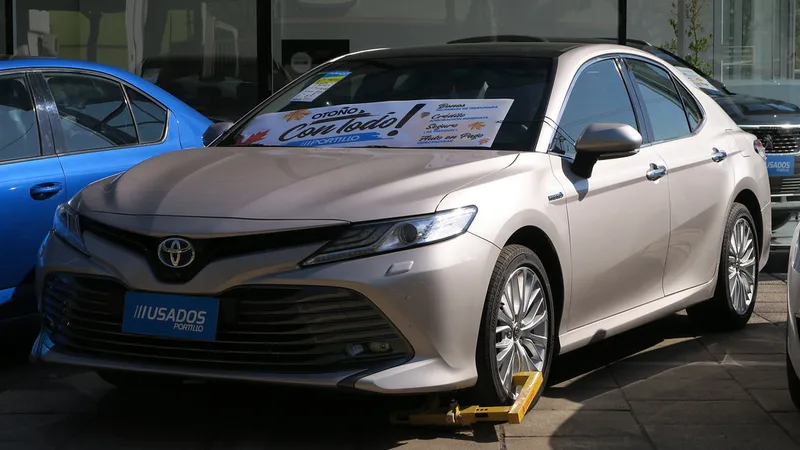
Toyota Camry Hybrid for Rideshare: The Sedan That Clears Uber Comfort
A 52-mpg sedan that clears Uber Comfort, at a running cost that trails the Prius by about 2.4 cents a mile.
- Energy 7.9¢/mi
- Maintenance 2.9¢/mi
- Depreciation 12.0¢/mi
Energy, maintenance and depreciation only, at $4.08/gal. Insurance, registration and any car payment sit on top — add yours in the cost per mile calculator.
| Spec | Toyota Camry Hybrid |
|---|---|
| Combined MPG | 52 |
| kWh / 100 mi | — |
| Used price range | $13,290–$24,100 |
| Maintenance per year | $442 |
| Seats | 5 |
| Cargo (cu ft) | 15.1 |
| Rear legroom (in) | 38 |
| Uber X | Yes |
| Uber Comfort | Yes |
| Uber XL | No |
Sources: EPA fuel economy, maintenance estimates, used price guide, Uber vehicle requirements . Updated 2026-08-27.
Where the Camry Hybrid wins
For a driver cross-shopping hybrids, the Camry Hybrid’s headline number is not its mpg — it ties the Prius at 52 mpg combined on the 2018-2024 generation this listing covers — but a box on Uber’s own eligibility page that the Prius cannot check. This car qualifies for Uber Comfort as well as Uber X, and Comfort trips route to a higher-paying tier of the platform. That single field in the spec table is arguably worth more to a full-time driver than any cost-per-mile figure below, because no amount of frugal driving turns an X fare into a Comfort fare in a car the platform has not approved for it.
The cost side still lands close to Prius territory. At 52 mpg combined and $4.085 a gallon — the fuel price this site’s calculators use everywhere — fuel runs about 7.9 cents a mile. Add 2.9 cents a mile in maintenance and 12.0 cents a mile in depreciation, and the three come to roughly 22.8 cents a mile before insurance, tires, or a car payment. Run that through a full-time driver’s 30,000-mile year, by this site’s working assumption, and fuel alone comes to about $2,357 — roughly 577 gallons at $4.085, the same gallon count as a Prius, since both cars get the same 52 mpg. Total running cost comes to about $6,827 a year. The current IRS standard mileage rate, 76 cents as of July 1, 2026, clears that real cost 3.3 times over — a comfortable margin, if not quite the Prius’s 3.73 times.
Where it does not
That thinner margin traces to one line: depreciation. At 12.0 cents a mile against a 52.7 percent share of the 22.8-cent total — just over half — this car loses more value per mile than the Prius does at 9.8 cents. Over a 30,000-mile year, that gap in depreciation, plus a smaller gap in maintenance, adds up to about $720 a year in extra running cost compared with a Prius that gets the identical 52 mpg. Uber Comfort eligibility is what a driver is buying with that difference, and it is only worth it if Comfort requests actually show up often enough on that driver’s account to cover it.
The used-price range is also wider here: $13,290 to $24,100, a $10,810 spread, compared with the Prius’s $8,790. Since depreciation is the largest single cost this car carries, that wider range means the gap between buying smart and buying at the top of the market matters even more than it does on a Prius.
Passenger space and luggage
Rear legroom of 38.0 inches beats the Prius’s 33.4 by nearly five inches, which shows up on a longer ride with a full back seat — exactly the kind of trip Comfort routing sends this car’s way. Cargo space tells the opposite story: 15.1 cubic feet, just over half the Prius’s 27.4, because a sedan trunk is shaped differently than a hatchback’s cargo area even when the car sitting on top of it is larger overall. In practical terms, 15.1 cubic feet holds two suitcases and a couple of soft bags; a third passenger’s rolling bag has to ride on a lap or in a footwell. Five seats put the same four-passenger ceiling on this car as on the Prius, just reached with less visual warning since the Camry looks like the bigger car from outside.
Maintenance and the battery question
The published maintenance figure is $442 a year, sourced to CarEdge, which like every average in this dataset assumes a private driver’s ordinary mileage. Scaled to this site’s 2.9-cent-a-mile rate instead, a full-time 30,000-mile year works out to about $870 — nearly double the published average, because a rideshare Camry Hybrid covers two to three times the miles a typical owner logs in the same twelve months. Neither figure is wrong; they answer different questions, and a driver budgeting for full-time use should budget against the per-mile rate.
The hybrid battery question gets the same honest answer here as it does for every hybrid in this dataset: there is no separate line item for it. The 2.9-cent rate is an average across whatever mix of battery-related and ordinary service CarEdge’s estimate is built from. A driver who needs a replacement pack outside that average pays well above 2.9 cents a mile in the year it happens, and no average predicts in advance which driver that will be.
Does it pay for itself?
At about $6,827 a year in fuel, maintenance, and depreciation for 30,000 miles, whether this car pays for itself depends on fares and hours behind the wheel — numbers this dataset does not track. What the figures above do support is the running-cost half of that question: 22.8 cents a mile, or the combined mpg and per-mile maintenance and depreciation figures straight from the spec table, is the input a payback-period calculation needs before a purchase price in the $13,290-$24,100 range turns into a number of weeks rather than an abstraction. A rideshare profit calculation needs the same figure to turn a gross fare number into something closer to what actually lands in a driver’s pocket after energy, maintenance, and depreciation come out of it.
The IRS mileage rate itself is worth a note on its own. It moved from 72.5 cents in the first half of 2026 to 76 cents on July 1 — a 3.5-cent step that changes nothing about what this car costs to run, but adds about $1,050 to what a full 30,000-mile year is worth on a tax return, compared with the same mileage under the earlier rate.
Verdict
The Camry Hybrid is the pick for a driver who wants the Comfort tier and is willing to pay roughly $720 a year more than a Prius to get it — a fair trade if Comfort fares show up often enough on that driver’s account to cover the difference. It is a weaker pick for a driver who never sees Comfort requests, or who needs cargo room over legroom, since the Prius’s 27.4 cubic feet is roughly 80 percent more than this car’s 15.1 for the same passenger capacity. The Honda Accord Hybrid, at a lower 48 mpg but a similar Comfort-eligible profile and a slightly cheaper price floor, is the next car worth running through this same math for a driver chasing the same fare tier at a lower entry price.