Review
Kia Niro for Rideshare: The Cheapest Entry Price Among the Hybrids
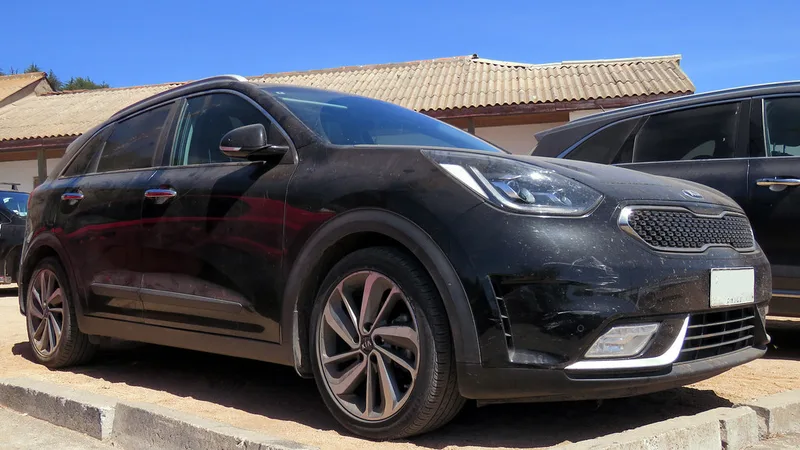
An $8,093 price floor and 22.4 cubic feet of cargo make this the value pick among hybrids, if Uber X is the only tier a driver needs.
- Energy 8.3¢/mi
- Maintenance 2.5¢/mi
- Depreciation 13.5¢/mi
Energy, maintenance and depreciation only, at $4.08/gal. Insurance, registration and any car payment sit on top — add yours in the cost per mile calculator.
| Spec | Kia Niro |
|---|---|
| Combined MPG | 49 |
| kWh / 100 mi | — |
| Used price range | $8,093–$18,239 |
| Maintenance per year | $377 |
| Seats | 5 |
| Cargo (cu ft) | 22.4 |
| Rear legroom (in) | 37.4 |
| Uber X | Yes |
| Uber Comfort | No |
| Uber XL | No |
Sources: EPA fuel economy, maintenance estimates, used price guide, Uber vehicle requirements . Updated 2026-08-27.
Where the Niro wins
The Niro’s used-price range starts at $8,093 — the lowest floor of any vehicle in this dataset, hybrid or otherwise. The next-lowest floor belongs to the Bolt EV at $8,587, an EV rather than a hybrid, just $494 above the Niro; the next hybrid’s floor, the Prius’s $11,360, sits $3,267 above it. The top of the Niro’s range, $18,239, is also below every hybrid sedan reviewed on this site except the Corolla Hybrid’s $18,210. For a driver whose first constraint is how much cash a car requires up front, that combination — a genuinely low floor and a capped ceiling — is the strongest argument this crossover has.
On the 2017-2022 generation this listing covers, the Niro is rated 49 mpg combined, which at $4.085 a gallon works out to about 8.3 cents a mile in fuel. Add 2.5 cents a mile in maintenance and 13.5 cents a mile in depreciation, and the total comes to roughly 24.3 cents a mile — better than the Corolla Hybrid’s 26.5, the Civic’s 27.3, and the Sonata Hybrid’s 25.7, though not as low as the Prius’s 20.4 or the Accord Hybrid’s 22.6. Annual fuel cost at a full-time driver’s 30,000-mile year comes to about $2,501 — 612 gallons at $4.085. Total running cost for the same year comes to about $7,301, and the current 76-cent IRS mileage rate clears that 3.12 times over.
Cargo space of 22.4 cubic feet ranks fourth among the eight hybrids in this dataset — behind the RAV4 Hybrid’s 37.6, the Sienna’s 33.5, and the Prius’s 27.4 — but it beats every hybrid sedan in this dataset by a wide margin, and it comes in a crossover body that sits higher off the ground than any sedan reviewed on this site — a real advantage for loading bulkier items than a suitcase.
Where it does not
The Niro is rated for Uber X only — no Comfort, the same ceiling as the Prius, Corolla Hybrid, and Sonata Hybrid — so a driver gets none of the fare-tier upside the Camry Hybrid or Accord Hybrid offers. Depreciation of 13.5 cents a mile makes up 55.5 percent of this car’s total cost, more than half, and slightly worse than the Camry Hybrid’s 52.7 percent share despite the Niro’s much lower purchase price — a reminder that a cheap car and a car that holds its value well are not automatically the same thing.
Rear legroom of 37.4 inches ties the Civic and beats the Corolla Hybrid’s and Sonata Hybrid’s 34.8, though it trails the Camry Hybrid’s 38.0 and the Accord Hybrid’s 40.4 — a genuine strength for a crossover often overlooked next to sedans on comfort, if not a class-leading one. Even so, the missing Comfort eligibility means that legroom advantage never reaches a fare tier built to reward it.
Passenger space and luggage
At 22.4 cubic feet, cargo space here beats every hybrid sedan reviewed on this site by a wide margin — between 5.7 and 7.3 cubic feet more than the Camry Hybrid, Accord Hybrid, or Sonata Hybrid, and more than 70 percent larger than the Corolla Hybrid’s 13.1. That is enough room for two large suitcases and several soft bags without the packing compromises a sedan trunk forces. Rear legroom of 37.4 inches supports the same conclusion: five seats, a four-passenger ceiling, but a middle-seat rider fares better here than in most of this dataset’s sedans, short of the Accord Hybrid.
Maintenance and the battery question
The published maintenance estimate is $377 a year, sourced to RepairPal and built around a typical private driver’s mileage. Scaled to this site’s 2.5-cent-a-mile rate instead, a full-time 30,000-mile year comes to about $750 — roughly double the published figure, the same pattern every hybrid in this dataset shows once mileage scales from a typical owner’s use to a full-time driver’s.
The hybrid battery question has the same honest answer here as elsewhere in this dataset: there is no separate line item for it. The 2.5-cent rate is RepairPal’s average across whatever mix of ordinary and battery-related service its sample includes for this model. It is an average, not a warranty — a driver whose pack needs replacement outside that average pays well above 2.5 cents a mile in the year it happens, and no average says in advance which driver that will be.
Does it pay for itself?
At about $7,301 a year in fuel, maintenance, and depreciation for 30,000 miles, whether the Niro pays for itself depends on fares and hours behind the wheel — numbers this dataset does not track. What the figures above supply is the running-cost half of the question: 24.3 cents a mile, or the combined mpg, maintenance rate, and depreciation rate straight from the spec table, is what a payback-period calculation needs before a purchase price in the $8,093-$18,239 range turns into a concrete number of weeks — and with this car’s price floor the lowest in the dataset, that calculation starts from the most favorable position of any hybrid reviewed here. The same figure, run through a rideshare profit calculation, turns a gross fare number into something closer to what a driver actually keeps.
The IRS mileage rate moved from 72.5 cents in the first half of 2026 to 76 cents on July 1 — a 3.5-cent step that changes nothing about what this car costs to run but adds about $1,050 to what a full 30,000-mile year is worth on a tax return compared with the earlier rate.
Verdict
The Niro is a strong pick for a driver working Uber X or delivery exclusively, who wants real cargo room and a low entry price more than a fare-tier upgrade, and who can find one at or near the bottom of its $8,093-$18,239 range. It is a weaker pick for a driver chasing Comfort fares, since neither the Niro’s price nor its cargo space buys that eligibility — the Camry Hybrid or Accord Hybrid does that instead, at a higher price floor. A side-by-side against the Prius, its closest rival on both price floor and Uber X-only ceiling, is the natural next comparison for a driver choosing between the two on cargo room alone.