Comparison
Corolla Hybrid vs Civic: Does the Fuel Savings Survive Depreciation?
Corolla Hybrid is still cheaper overall, by 0.8 cents a mile, but its steep depreciation erodes most of its fuel advantage over the Civic.

- Energy 7.9¢/mi
- Maintenance 2.4¢/mi
- Depreciation 16.2¢/mi
- Energy 11.7¢/mi
- Maintenance 2.5¢/mi
- Depreciation 13.1¢/mi
Energy, maintenance and depreciation only, at $4.08/gal. Insurance, registration and any car payment sit on top — add yours in the cost per mile calculator.
| Spec | Toyota Corolla Hybrid | Honda Civic |
|---|---|---|
| Combined MPG | 52 | 35 |
| kWh / 100 mi | — | — |
| Used price range | $13,360–$18,210 | $16,170–$22,043 |
| Maintenance per year | $362 | $368 |
| Seats | 5 | 5 |
| Cargo (cu ft) | 13.1 | 14.8 |
| Rear legroom (in) | 34.8 | 37.4 |
| Uber X | Yes | Yes |
| Uber Comfort | No | No |
| Uber XL | No | No |
Sources: Toyota Corolla Hybrid — EPA fuel economy, maintenance estimates, used price guide, Uber vehicle requirements ; Honda Civic — EPA fuel economy, maintenance estimates, used price guide, Uber vehicle requirements . Updated 2026-08-27.
The short answer
On paper, this should not be close: the Corolla Hybrid’s 52 mpg combined against the Civic’s 35 mpg is a wide fuel-economy gap, and gas at $4.085 a gallon makes that gap expensive for the Civic. But the Corolla Hybrid gives most of that advantage back in depreciation, which is the steepest of any hybrid sedan in this dataset. The Corolla Hybrid still wins on total cost per mile — 26.5 cents against the Civic’s 27.3 cents — but the margin, 0.8 cents a mile, is far smaller than the fuel numbers alone suggest.
Cost per mile
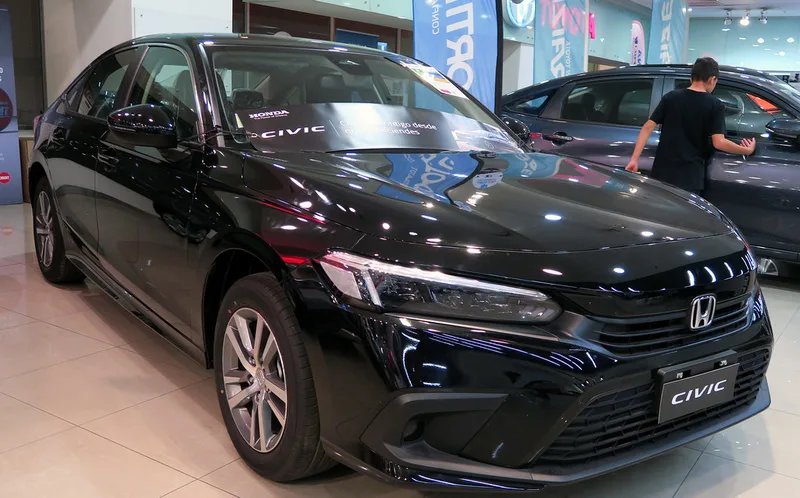
Fuel is where the Corolla Hybrid’s advantage lives: 7.9 cents a mile at 52 mpg combined, against 11.7 cents a mile for the Civic at 35 mpg combined, both at $4.085 a gallon — a 3.8-cent-a-mile gap in the Corolla Hybrid’s favor. Maintenance is close: 2.4 cents a mile for the Corolla Hybrid, 2.5 cents for the Civic, a 0.1-cent difference that barely moves either total. Depreciation flips the story: 16.2 cents a mile for the Corolla Hybrid against 13.1 cents for the Civic, a 3.1-cent-a-mile gap that runs the other way, in the Civic’s favor.
Net it out and the Corolla Hybrid’s 3.8-cent fuel edge and 0.1-cent maintenance edge — 3.9 cents combined — are mostly canceled by its 3.1-cent depreciation disadvantage, leaving a net edge of just 0.8 cents a mile: 26.5 cents total for the Corolla Hybrid, 27.3 cents for the Civic. At a full-time driver’s 30,000-mile year, that is $7,937 for the Corolla Hybrid against $8,181 for the Civic — a $244 annual difference, not nothing, but a fraction of what a 17-mpg gap would suggest on its own. The current 76-cent IRS mileage rate covers the Corolla Hybrid’s real cost 2.87 times over and the Civic’s 2.79 times over — both comfortably covered, with the Corolla Hybrid a bit further ahead.
The reason the depreciation gap is so large comes down to how each car’s cost is structured. Depreciation is 61.2 percent of the Corolla Hybrid’s total per-mile cost — the highest depreciation share of any hybrid sedan in this dataset — against 48.0 percent for the Civic, where the bigger fuel bill keeps depreciation from dominating the total the way it does for the Corolla Hybrid. A driver deciding between these two is really deciding whether to trade fuel-station stops for exposure to a steeper resale curve.
Price
The Corolla Hybrid is also the cheaper car to buy at both ends of its range: $13,360 to $18,210 used against the Civic’s $16,170 to $22,043 — $2,810 cheaper at the floor, $3,833 cheaper at the ceiling. That price gap is part of what shows up as steep depreciation on the Corolla Hybrid’s side of the ledger: a car that costs less new-to-used tends to lose a larger share of its own value per mile, even when the dollar amount lost is similar.
Space and comfort
The Civic gives back some of what it loses on running cost in cabin space. Rear legroom is 37.4 inches on the Civic against 34.8 inches on the Corolla Hybrid, a 2.6-inch gap, and cargo space is 14.8 cubic feet against 13.1 cubic feet, a 1.7-cubic-foot edge for the Civic. Neither difference is large, but both favor the Civic, on top of its lower purchase price — the Civic is not without an argument here, it just does not win on running cost.
No hybrid battery, one less unknown
The Civic carries no hybrid battery at all, which removes one line item every hybrid review on this site has to flag as an averaged risk rather than a guarantee: the possibility of an out-of-warranty pack replacement landing on one driver’s ledger and not another’s. The Corolla Hybrid’s 2.4-cent maintenance figure, like every hybrid’s on this site, is an average across the fleet RepairPal draws from, not a promise for any individual car. That is not a reason by itself to pick the Civic — its own maintenance figure is barely different, at 2.5 cents — but it is one less variable to think about for a driver who would rather budget around a conventional powertrain’s known failure modes than an averaged battery-service estimate.
Which one to buy
The Corolla Hybrid remains the lower-total-cost car, at 26.5 cents a mile against the Civic’s 27.3, and it is cheaper to buy across its whole price range. That makes it the better pick on the numbers for a driver focused purely on running cost. The Civic’s case is that its advantage is smaller than a quick mpg comparison implies — 0.8 cents a mile, not the 3.8-cent gap fuel alone would suggest — while offering more rear legroom, more cargo space, and one less unknown in the powertrain. Both qualify for Uber X only; neither clears Comfort or XL, so eligibility does not break the tie. Full breakdowns of both cars are in the Toyota Corolla Hybrid review and the Honda Civic review.